Read the following:
Identify Freud’s psychosexual stages of development, and describe the effects of fixation on behavior.
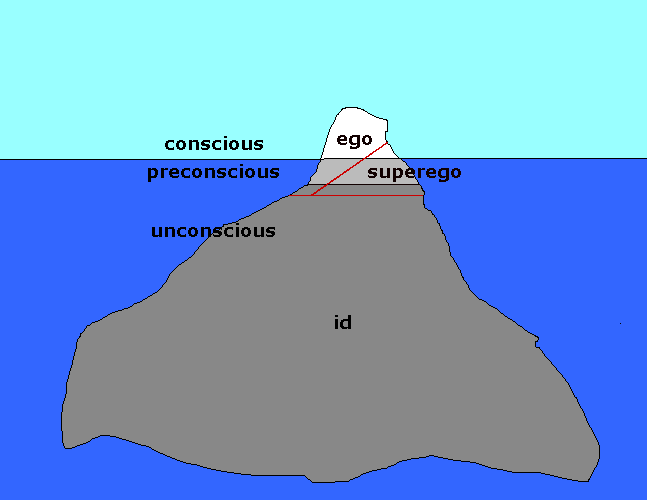
Freud maintained that children pass through a series of psychosexual stages during which the id’s pleasure-seeking energies focus on distinct pleasure-sensitive areas of the body called erogenous zones.
• oral stage (0–18 months), pleasure centers on the mouth
• anal stage (18–36 months) on bowel/bladder elimination.
• phallic stage (3–6 years), pleasure centers on the genitals.
Boys experience the Oedipus complex, with unconscious sexual desires toward their mother and hatred of their father. They cope with these threatening feelings through identification with their father, thereby incorporating many of his values and developing a sense of gender identity.
• latency stage (6 years to puberty), in which sexuality is dormant (repression of desires)
• genital stage (puberty on) as youths begin to experience sexual feelings toward others.
maladaptive adult behavior results from conflicts unresolved during the oral, anal, and phallic stages. At any point, conflict can lock, or fixate, the person’s pleasure-seeking energies in that stage.
Describe the function of defense mechanisms, and identify six of them.
Defense mechanisms reduce or redirect anxiety in various ways, but always by distorting reality.
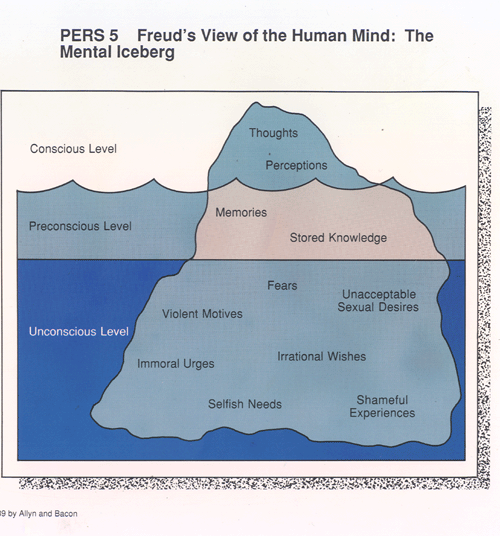
o Repression, which underlies the other defense mechanisms, banishes anxiety-arousing thoughts from consciousness;
o regression involves retreat to an earlier, more infantile stage of development;
o reaction formation makes unacceptable impulses look like their opposites.
o Projection attributes threatening impulses to others
o rationalization offers self-justifying explanations for behavior
o displacement diverts impulses to a more acceptable object.
Contrast the views of the neo-Freudians and psychodynamic theorists with Freud’s original theory.
The neo-Freudians accepted Freud’s basic ideas regarding personality structures, the importance of the unconscious, the shaping of personality in children, and the dynamics of anxiety and defense mechanisms.
However, in contrast to Freud, the neo-Freudians generally placed more emphasis on the conscious mind in interpreting experience and coping with the environment, and they argued that we have more positive motives than sex and aggression.
Unlike other neo-Freudians, Carl Jung agreed with Freud that the unconscious exerts a powerful influence. In addition, he suggested that the collective unconscious is a shared, inherited reservoir of memory traces from our species’ history. Contemporary psychodynamic theorists and therapists reject the notion that sex is the basis of personality but agree with Freud that much of our mental life is unconscious, that we struggle with inner conflicts, and that childhood shapes our personalities and attachment styles.
Describe two projective tests used to assess personality, and discuss some criticisms of them.
Projective tests provide ambiguous stimuli that are designed to trigger projection of one’s inner dynamics.
o Thematic Apperception Test, people view ambiguous pictures and then make up stories about them. Presumably their accounts reflect their interests and inner feelings.
o The Rorschach Inkblot Test seeks to identify people’s inner feelings and conflicts by analyzing their interpretations of 10 inkblots. Critics question the validity and reliability of the tests. Nonetheless many clinicians continue to use them.
Summarize psychology’s current assessment of Freud’s theory of psychoanalysis.
Critics contend that many of Freud’s specific ideas are implausible, unvalidated, or contradicted by new research, and that his theory offers only after-the-fact explanations. Recent findings question the overriding importance of childhood experiences, the degree of parental influence, the timing of gender-identity formation, the significance of childhood sexuality, and the existence of hidden content in dreams. Many researchers now believe that repression rarely, if ever, occurs. Nevertheless, Freud drew psychology’s attention to the unconscious and to our struggle to cope with anxiety and sexuality. Indeed, studies testing terror-management theory show that thinking about one’s mortality provokes enough anxiety to intensify prejudices. Freud also focused attention on the conflict between biological impulses and social restraints. Unquestionably, his cultural impact has been enormous.
The Humanistic Perspective
Summarize Abraham Maslow’s concept of self-actualization, and explain how his ideas illustrate the humanistic perspective.
According to Maslow, self-actualization is the motivation to fulfill one’s potential. It is the ultimate psychological need that arises after basic physical and psychological needs are met and self-esteem is achieved.
11. Discuss Carl Rogers’ person-centered perspective, and explain the importance of unconditional positive regard.
Carl Rogers agreed with Maslow that people are basically good and are endowed with self-actualizing tendencies. To nurture growth in others, Rogers advised being genuine, empathic, and accepting (offering unconditional positive regard). In such a climate, people can develop a deeper self-awareness and a more realistic and positive self-concept.
Explain how humanistic psychologists assessed personality.
Humanistic psychologists assessed personality through questionnaires on which people report their self-concept (who am I?). One questionnaire asked people to compare their actual self with their ideal self. Other humanistic psychologists maintained that we can only understand each person’s unique experience through interviews and intimate conversations.
State the major criticisms of the humanistic perspective on personality.
First, critics complain that the perspective’s concepts are vague and subjective. For example, the description of self-actualizing people seems more a reflection of Maslow’s personal values than a scientific description. Second, the individualism promoted by humanistic psychology may promote self-indulgence, selfishness, and an erosion of moral restraints. Third, humanistic psychology fails to appreciate the reality of our human capacity for evil. Its naive optimism may lead to apathy about major social problems.
The Trait Perspective
Cite the main difference between the trait and psychoanalytic perspectives on personality.
o trait theorists attempt to describe personality in terms of stable and enduring behavior patterns, or dispositions to feel and act.
o Some theorists use dominant traits and their associated characteristics to describe personality “types.”
Describe some of the ways psychologists have attempted to compile a list of basic personality traits.
One way has been to suggest traits, such as anxiety, that some theory regards as basic. A newer technique is factor analysis, a statistical procedure that identifies clusters of behaviors that tend to appear together. For example, through factor analysis, Hans and Sybil Eysenck reduced normal variations to two or three genetically influenced dimensions, including extraversion–introversion and emotional stability–instability. Brain activity scans suggest that extraverts and introverts differ in their level of arousal, with extraverts seeking stimulation because their normal brain arousal level is relatively low. Jerome Kagan maintains that heredity, by influencing autonomic nervous system arousal, also affects our temperament and behavioral style, which help define our
personality.
Explain how psychologists use personality inventories to assess traits, and discuss the most widely used of these inventories.
Psychologists assess several traits at once by administering personality inventories on which people respond to items designed to measure a wide range of feelings and behaviors.
o The Minnesota Multiphasic Personality Inventory (MMPI) is the most widely used personality inventory. Originally developed to identify emotional disorders, this test is now used for many other screening purposes. The MMPI items were empirically derived—that is, from a large pool of items, the test developers selected those on which particular diagnostic groups differed. The objective scoring of the test does not guarantee its validity. For example, those taking the MMPI for employment screening may give socially desirable responses that create a good impression.
Identify the Big Five personality factors, and discuss some of the strengths of this approach to studying personality.
Researchers have isolated five distinct personality dimensions, dubbed the Big Five: emotional stability, extraversion, openness, agreeableness, and conscientiousness. These traits appear to be stable in adulthood, largely heritable, common to all cultures, and good predictors of other personal attributes. Locating an individual on these five dimensions provides a comprehensive picture of personality.
Summarize the person-situation controversy, and explain its importance as a commentary on the trait perspective.
Although people’s traits seem to persist over time, critics of the trait perspective note that human behavior varies widely from situation to situation. Thus, traits are not good predictors of behavior. For example, being conscientious on one occasion is only modestly related to being conscientious on another occasion. Defenders of the trait perspective note that, despite these variations, a person’s average behavior across different situations is fairly consistent. We do have distinct personality traits. Moreover, research suggests that our traits are socially significant; they influence our health, our thinking, and our job performance.
Explain why psychologists are interested in the consistency of the trait of expressiveness.
In informal social situations, our expressive styles—our animation, manner of speaking, and gestures—are impressively consistent. Moreover, we can judge individual differences in expressiveness in a matter of seconds. Thus, we may form lasting impressions within a few moments of meeting someone. Research suggests people have little voluntary control over their expressiveness.
Monday, March 30, 2009

Sunday, March 22, 2009
Thursday, March 19, 2009
Assignment: March 19, 2009
If you failed to complete the critical thinking questions from Tuesday do so now. I will collect on Monday.
ESSAY:
Think about a time you faced a stressful event. How did you appraise the stress, and how did you respond? Give specific examples from YOUR experience, relating it to the psychological perspective of stress (i.e. psychopsysiological effects, 5 stages of stress, etc.). Use your POWERPOINT (STRESS) to assist you. If you did not pick up your POWERPOINT last class, it is on the desk and needs to be stapled.
When you are done:
Go to PsychSim (the link is at the bottom) and complete the activity "All Stressed Out."
This will be collected on Monday...remember grades close on Thursday, and that "C" many of you received for progress reports was out of pity. I love you all. Goodbye.
ESSAY:
Think about a time you faced a stressful event. How did you appraise the stress, and how did you respond? Give specific examples from YOUR experience, relating it to the psychological perspective of stress (i.e. psychopsysiological effects, 5 stages of stress, etc.). Use your POWERPOINT (STRESS) to assist you. If you did not pick up your POWERPOINT last class, it is on the desk and needs to be stapled.
When you are done:
Go to PsychSim (the link is at the bottom) and complete the activity "All Stressed Out."
This will be collected on Monday...remember grades close on Thursday, and that "C" many of you received for progress reports was out of pity. I love you all. Goodbye.
Monday, March 16, 2009
Endorphins & Stress
Below is the information regarding today's assignment. Please complete on a separate sheet of paper. Also, review your PowerPoint for Stress & Health. This PowerPoint came from the textbook as opposed to being my creation.
When you are done with the critical thinking activity follow the link to some interactive activities that help you review previously covered material. These links lead to BBC. Please list the results of your surveys/activities on the separate sheet of paper.
--------------------------------------------------------------------
As you may recall from earlier in the text, endorphins [short for endogenous (produced from within) morphine] are natural opiate-like neurotransmitters that the body releases in response to pain and vigorous exercise (for a quick refresher visit: http://stress.about.com/b/a/010548.htm). Researchers have recently found that endorphin levels vary with how stressful a situation is perceived to be. In one study, well-trained long-distance runners were asked to work out two times on a motorized treadmill, once with and once without taped music being played. The speed and elevation of the treadmill was controlled so that for each athlete the physical exertion required in the two conditions was the same. All the athletes reported that the workout seemed less strenuous when they were listening to music. Physiologically, their bodies corroborated this perception. Endorphin levels were significantly lower in the music condition than in the no-music condition.
1. What do the results of this study demonstrate regarding the importance of cognitive appraisal in determining the physiological response to a stressful situation?
2. In what practical ways could the findings of this study be applied to other stressful situations?
3. What are some of the general health implications of the results of this study?
In another recent study, researchers asked groups of women and men to watch either a highly stressful film about woodshop accidents or a pleasant travelogue. Within the subjects' reach were bowls of salty peanuts, bland rice cakes, and sweet M&M's. The bowls were weighed before and after each session to determine how much of each snack food the subjects consumed. Surprisingly, the researchers found that the subjects who watched the stressful film consumed fewer sweet snacks than did the subjects who watched the nonstressful film. This was true for the entire group of men, and for those women who reported few concerns about dieting and body weight. The only subjects who consumed more sweet snacks in the stressful condition than did those in the nonstressful condition were women who reported being especially conscious of their weight and who had a dietary history of frequent dieting. Stress did not significantly influence the subjects' preferences for salty or bland snack foods.
Why should people have less of an appetite for sweets when they are stressed? Can you think of a possible explanation for this phenomenon, as well as the gender difference in taste sensitivity? How might these results be applied to help dieters?
-----
ACTIVITIES
What sex is YOUR brain? Click HERE
Can you spot a fake smile? Click HERE
What kind of thinker are you? Click HERE
Play the Nervous System Game. Click HERE
When you are done with the critical thinking activity follow the link to some interactive activities that help you review previously covered material. These links lead to BBC. Please list the results of your surveys/activities on the separate sheet of paper.
--------------------------------------------------------------------
As you may recall from earlier in the text, endorphins [short for endogenous (produced from within) morphine] are natural opiate-like neurotransmitters that the body releases in response to pain and vigorous exercise (for a quick refresher visit: http://stress.about.com/b/a/010548.htm). Researchers have recently found that endorphin levels vary with how stressful a situation is perceived to be. In one study, well-trained long-distance runners were asked to work out two times on a motorized treadmill, once with and once without taped music being played. The speed and elevation of the treadmill was controlled so that for each athlete the physical exertion required in the two conditions was the same. All the athletes reported that the workout seemed less strenuous when they were listening to music. Physiologically, their bodies corroborated this perception. Endorphin levels were significantly lower in the music condition than in the no-music condition.
1. What do the results of this study demonstrate regarding the importance of cognitive appraisal in determining the physiological response to a stressful situation?
2. In what practical ways could the findings of this study be applied to other stressful situations?
3. What are some of the general health implications of the results of this study?
In another recent study, researchers asked groups of women and men to watch either a highly stressful film about woodshop accidents or a pleasant travelogue. Within the subjects' reach were bowls of salty peanuts, bland rice cakes, and sweet M&M's. The bowls were weighed before and after each session to determine how much of each snack food the subjects consumed. Surprisingly, the researchers found that the subjects who watched the stressful film consumed fewer sweet snacks than did the subjects who watched the nonstressful film. This was true for the entire group of men, and for those women who reported few concerns about dieting and body weight. The only subjects who consumed more sweet snacks in the stressful condition than did those in the nonstressful condition were women who reported being especially conscious of their weight and who had a dietary history of frequent dieting. Stress did not significantly influence the subjects' preferences for salty or bland snack foods.
Why should people have less of an appetite for sweets when they are stressed? Can you think of a possible explanation for this phenomenon, as well as the gender difference in taste sensitivity? How might these results be applied to help dieters?
-----
ACTIVITIES
What sex is YOUR brain? Click HERE
Can you spot a fake smile? Click HERE
What kind of thinker are you? Click HERE
Play the Nervous System Game. Click HERE
Wednesday, March 4, 2009
ASSIGNMENT: March 5th 2009
Please write your responses on a separate sheet of paper (not on the blog). On Monday, we will briefly go over the aspects of work, particularly incentives, and move onto EMOTION (Ch. 13). Your Question packet will include questions from both Ch. 12 & Ch. 13.
At this time you should have completed reading for Ch. 12 (Motivation). This weekend begin reading for Ch. 13 (Emotion). YOU MUST READ through the first 12 objectives of Ch. 13. You will be quizzed on this information on Monday.
When you have completed the following questions please scroll down to the PsychSim and complete the "Hunger and the Fat Rat" & "Expressing Emotion" activities.
At this time you should have completed reading for Ch. 12 (Motivation). This weekend begin reading for Ch. 13 (Emotion). YOU MUST READ through the first 12 objectives of Ch. 13. You will be quizzed on this information on Monday.
When you have completed the following questions please scroll down to the PsychSim and complete the "Hunger and the Fat Rat" & "Expressing Emotion" activities.
Answer these questions:
1. What is motivation and how is it explained by instinct theory, evolutionary psychology, drive-reduction theory and arousal theory?
2. How does Maslow’s hierarchy of needs explain behavior?
3. What is the physiology and psychology of hunger and eating behavior?
4. What are some possible explanations for the rise in eating disorders?
5. What is the physiology and psychology of sexual behavior?
6. What factors influence teenagers’ sexual attitudes and behaviors?
7. What does current research tell us about sexual orientation? (Please do not answer questions on sexual orientation based on your OPINION. On the AP Exam the answers are based on research, not your opinion).
8. What are the characteristic differences between bulimia and anorexia?
9. Define Homeostasis and provide an example.
10. When students are rewarded for outstanding performance with stickers on their papers the practice best illustrates the use of what?
ALSO COMPLETE:
Anorexia Nervosa
This exercise examines the eating disorder anorexia nervosa, including the symptoms, treatment options, and new research findings that are unlocking the causes of this disorder. This exercise will also introduce you to the features of the Internet Mental Health Web site and the homepage for the National Association of Anorexia Nervosa and Associated Disorders (ANAD), probably your two best Web resources for information on mental disorders.
http://www.mentalhealth.com/p20-grp.html
http://www.anad.org/site/anadweb/
1. Treatment for anorexia nervosa must address both the medical/physiological and psychosocial roots of this disorder. Briefly describe the various medical and psychosocial treatment options available for individuals with anorexia nervosa.
2. Select an article from the "Magazine" section of the Internet Mental Health Web site and summarize its contents.
Monday, February 23, 2009


Tuesday, February 3, 2009
Dead athletes' brains show damage from concussions
(CNN) -- For years after his NFL career ended, Ted Johnson could barely muster the energy to leave his house
"I'd [leave to] go see my kids for maybe 15 minutes," said Johnson. "Then I would go back home and close the curtains, turn the lights off and I'd stay in bed. That was my routine for two years.
"Those were bad days."
These days, the former linebacker is less likely to recount the hundreds of tackles, scores of quarterback sacks or the three Super Bowl rings he earned as a linebacker for the New England Patriots. He is more likely to talk about suffering more than 100 concussions.
"I can definitely point to 2002 when I got back-to-back concussions. That's where the problems started," said Johnson, who retired after those two concussions. "The depression, the sleep disorders and the mental fatigue."
Until recently, the best medical definition for concussion was a jarring blow to the head that temporarily stunned the senses, occasionally leading to unconsciousness. It has been considered an invisible injury, impossible to test -- no MRI, no CT scan can detect it. Watch more on what goes on in athlete's brains »
But today, using tissue from retired NFL athletes culled posthumously, the Center for the Study of Traumatic Encephalopathy (CSTE), at the Boston University School of Medicine, is shedding light on what concussions look like in the brain. The findings are stunning. Far from innocuous, invisible injuries, concussions confer tremendous brain damage. That damage has a name: chronic traumatic encephalopathy (CTE).
On Tuesday afternoon, researchers at the CSTE released a study about the sixth documented case of CTE in former NFL player Tom McHale, who died in 2008 at the age of 45, and the youngest case to date, an 18-year-old multi-sport athlete who suffered multiple concussions.
While CTE in an ex-NFL player's brain may have been expected, the beginnings of brain damage in an 18-year-old brain was a "shocking" finding, according to Dr. Ann McKee, a neuropathologist at the Veterans Administration Hospital in Bedford, Massachusetts, and co-director of the CSTE.
"We think this is how chronic traumatic encephalopathy starts," said McKee. "This is speculation, but I think we can assume that this would have continued to expand."
CTE has thus far been found in the brains of six out of six former NFL players.
"What's been surprising is that it's so extensive," said McKee. "It's throughout the brain, not just on the superficial aspects of the brain, but it's deep inside."
CSTE studies reveal brown tangles flecked throughout the brain tissue of former NFL players who died young -- some as early as their 30s or 40s.
McKee, who also studies Alzheimer's disease, says the tangles closely resemble what might be found in the brain of an 80-year-old with dementia.
"I knew what traumatic brain disease looked like in the very end stages, in the most severe cases," said McKee. "To see the kind of changes we're seeing in 45-year-olds is basically unheard of."
The damage affects the parts of the brain that control emotion, rage, hypersexuality, even breathing, and recent studies find that CTE is a progressive disease that eventually kills brain cells.
Chris Nowinski knows well the impact of concussions. He was a football star at Harvard before wrestling professionally with World Wrestling Entertainment.
In one moment, his dreams of a long career wrestling were dashed by a kick to his chin. That kick, which caused Nowinski to black out and effectively ended his career, capped a career riddled with concussions.
"My world changed," said Nowinski. "I had depression. I had memory problems. My head hurt for five years."
Nowinski began searching for studies, and what he found startled him.
"I realized when I was visiting a lot of doctors, they weren't giving me very good answers about what was wrong with my head," said Nowinski. "I read [every study I could find] and I realized there was a ton of evidence showing concussions lead to depression, and multiple concussion can lead to Alzheimer's."
Nowinski decided further study was needed, so he founded the Sports Legacy Institute along with Dr. Robert Cantu, a neurosurgeon and the co-director of the CSTE. The project solicits for study the brains of ex-athletes who suffered multiple concussions.
Once a family agrees to donate the brain, it is delivered to scientists at the CSTE to look for signs of damage.
So far, the evidence of CTE is compelling.
The Center for the Study of Traumatic Encephalopathy, along with other research institutions, has now identified traumatic encephalopathy in the brains of late NFL football players John Grimsley, Mike Webster, Andre Waters, Justin Strzelczyk and Terry Long, in addition to McHale.
Grimsley died of an accidental gunshot wound to the chest. Webster, Long and Strzelczyk all died after long bouts of depression, while Waters committed suicide in 2006 at age 44. McHale was found dead last year of an apparent drug overdose.
"Guys were dying," said Nowinski. "The fact of the matter was guys were dying because they played sports 10 or 20 years before."
So far, around 100 athletes have consented to have their brains studied after they die.
Ted Johnson was one of the first to sign up. He said he believes that concussions he suffered while playing football explain the anger, depression and throbbing headaches that occasionally still plague him.
Johnson said he played through concussions because he, like many other NFL athletes, did not understand the consequences. He has publicly criticized the NFL for not protecting players like him.
"They don't want you to know," said Johnson. "It's not like when you get into the NFL there's a handout that says 'These are the effects of multiple concussions so beware.' "
In a statement, the NFL indicated that their staffs take a cautious, conservative approach to managing concussions.
While they support research into the impact of concussions, they maintain that, "Hundreds of thousands of people have played football and other sports without experiencing any problem of this type and there continues to be considerable debate within the medical community on the precise long-term effects of concussions and how they relate to other risk factors."
The NFL is planning its own independent medical study of retired NFL players on the long-term effects of concussion.
"Really my main reason even for talking about this is to help the guys who are already retired," said Johnson. "[They] are getting divorced, going bankrupt, can't work, are depressed, and don't know what's wrong with them. [It is] to give them a name for it so they can go get help."
"The idea that you can whack your head hundreds of times in your life and knock yourself out and get up and be fine is gone," said Nowinski. "We know we can't do that anymore. This causes long-term damage."
"I'd [leave to] go see my kids for maybe 15 minutes," said Johnson. "Then I would go back home and close the curtains, turn the lights off and I'd stay in bed. That was my routine for two years.
"Those were bad days."
These days, the former linebacker is less likely to recount the hundreds of tackles, scores of quarterback sacks or the three Super Bowl rings he earned as a linebacker for the New England Patriots. He is more likely to talk about suffering more than 100 concussions.
"I can definitely point to 2002 when I got back-to-back concussions. That's where the problems started," said Johnson, who retired after those two concussions. "The depression, the sleep disorders and the mental fatigue."
Until recently, the best medical definition for concussion was a jarring blow to the head that temporarily stunned the senses, occasionally leading to unconsciousness. It has been considered an invisible injury, impossible to test -- no MRI, no CT scan can detect it. Watch more on what goes on in athlete's brains »
But today, using tissue from retired NFL athletes culled posthumously, the Center for the Study of Traumatic Encephalopathy (CSTE), at the Boston University School of Medicine, is shedding light on what concussions look like in the brain. The findings are stunning. Far from innocuous, invisible injuries, concussions confer tremendous brain damage. That damage has a name: chronic traumatic encephalopathy (CTE).
On Tuesday afternoon, researchers at the CSTE released a study about the sixth documented case of CTE in former NFL player Tom McHale, who died in 2008 at the age of 45, and the youngest case to date, an 18-year-old multi-sport athlete who suffered multiple concussions.
While CTE in an ex-NFL player's brain may have been expected, the beginnings of brain damage in an 18-year-old brain was a "shocking" finding, according to Dr. Ann McKee, a neuropathologist at the Veterans Administration Hospital in Bedford, Massachusetts, and co-director of the CSTE.
"We think this is how chronic traumatic encephalopathy starts," said McKee. "This is speculation, but I think we can assume that this would have continued to expand."
CTE has thus far been found in the brains of six out of six former NFL players.
"What's been surprising is that it's so extensive," said McKee. "It's throughout the brain, not just on the superficial aspects of the brain, but it's deep inside."
CSTE studies reveal brown tangles flecked throughout the brain tissue of former NFL players who died young -- some as early as their 30s or 40s.
McKee, who also studies Alzheimer's disease, says the tangles closely resemble what might be found in the brain of an 80-year-old with dementia.
"I knew what traumatic brain disease looked like in the very end stages, in the most severe cases," said McKee. "To see the kind of changes we're seeing in 45-year-olds is basically unheard of."
The damage affects the parts of the brain that control emotion, rage, hypersexuality, even breathing, and recent studies find that CTE is a progressive disease that eventually kills brain cells.
Chris Nowinski knows well the impact of concussions. He was a football star at Harvard before wrestling professionally with World Wrestling Entertainment.
In one moment, his dreams of a long career wrestling were dashed by a kick to his chin. That kick, which caused Nowinski to black out and effectively ended his career, capped a career riddled with concussions.
"My world changed," said Nowinski. "I had depression. I had memory problems. My head hurt for five years."
Nowinski began searching for studies, and what he found startled him.
"I realized when I was visiting a lot of doctors, they weren't giving me very good answers about what was wrong with my head," said Nowinski. "I read [every study I could find] and I realized there was a ton of evidence showing concussions lead to depression, and multiple concussion can lead to Alzheimer's."
Nowinski decided further study was needed, so he founded the Sports Legacy Institute along with Dr. Robert Cantu, a neurosurgeon and the co-director of the CSTE. The project solicits for study the brains of ex-athletes who suffered multiple concussions.
Once a family agrees to donate the brain, it is delivered to scientists at the CSTE to look for signs of damage.
So far, the evidence of CTE is compelling.
The Center for the Study of Traumatic Encephalopathy, along with other research institutions, has now identified traumatic encephalopathy in the brains of late NFL football players John Grimsley, Mike Webster, Andre Waters, Justin Strzelczyk and Terry Long, in addition to McHale.
Grimsley died of an accidental gunshot wound to the chest. Webster, Long and Strzelczyk all died after long bouts of depression, while Waters committed suicide in 2006 at age 44. McHale was found dead last year of an apparent drug overdose.
"Guys were dying," said Nowinski. "The fact of the matter was guys were dying because they played sports 10 or 20 years before."
So far, around 100 athletes have consented to have their brains studied after they die.
Ted Johnson was one of the first to sign up. He said he believes that concussions he suffered while playing football explain the anger, depression and throbbing headaches that occasionally still plague him.
Johnson said he played through concussions because he, like many other NFL athletes, did not understand the consequences. He has publicly criticized the NFL for not protecting players like him.
"They don't want you to know," said Johnson. "It's not like when you get into the NFL there's a handout that says 'These are the effects of multiple concussions so beware.' "
In a statement, the NFL indicated that their staffs take a cautious, conservative approach to managing concussions.
While they support research into the impact of concussions, they maintain that, "Hundreds of thousands of people have played football and other sports without experiencing any problem of this type and there continues to be considerable debate within the medical community on the precise long-term effects of concussions and how they relate to other risk factors."
The NFL is planning its own independent medical study of retired NFL players on the long-term effects of concussion.
"Really my main reason even for talking about this is to help the guys who are already retired," said Johnson. "[They] are getting divorced, going bankrupt, can't work, are depressed, and don't know what's wrong with them. [It is] to give them a name for it so they can go get help."
"The idea that you can whack your head hundreds of times in your life and knock yourself out and get up and be fine is gone," said Nowinski. "We know we can't do that anymore. This causes long-term damage."
Subscribe to:
Posts (Atom)